Brief
Every month, Amplitude Energy’s five-person finance team had to manually reconcile balance sheets across dozens of accounts before the books could close, risking a compliance issue slipping through if anything was missed, so we built an agent that runs the reconciliation validation automatically inside their own Azure environment – checking every file, link, and sign-off, reporting back in plain language via Teams and email, while leaving every judgement call with the finance team.
Problem
Balance sheet reconciliation is one of those processes everyone agrees matters and nobody enjoys doing. At Amplitude Energy, it fell to a five-person finance team every single month – rolling forward master files, pulling the SAP trial balance, then working account by account through dozens of individual reconciliations to make sure everything tied out, every link pointed where it should, and every account that needed a preparer and reviewer actually had one. The work is unglamorous but the stakes aren’t. A missed reconciliation, a stale link, or a sign-off that never happened doesn’t just slow the close – it’s the kind of thing that turns up in an audit. And because the checking was manual, it was only as good as the person doing it that month. What the team needed wasn’t a faster spreadsheet. It was something that could run the same checks every time, catch what even a sharp reviewer occasionally misses, and still leave every decision that mattered in human hands.
Solution
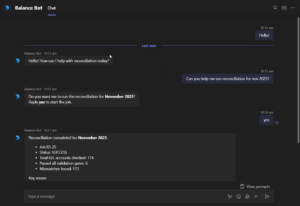
Finance still does what only finance should do – rolling the master file forward and loading the official SAP trial balance. From there, our agent takes over: it checks every reconciliation file exists, confirms every link and account reference is correct, verifies the right preparer and reviewer are attached to every account that needs one, and ties every balance back to SAP, reporting what it finds in Teams and email.
- Built as a hybrid, not a replacement – the agent never touches sign-off or judgement calls; those stay exactly where governance says they should, with the finance team.
- A gated control model – five separate validation gates catch different failure types, from missing files through to broken links to incomplete sign-off, so problems get caught at the right stage instead of buried in a wall of errors.
- Full audit trail, every run – every check, result, and file used is logged, so a question about a specific account three months later has a record to go back to.
- Investigate through chat – the team can ask the agent about a specific G/L account or a past run and get an answer straight from stored data, read-only, without reopening a single file.
- Deployed twice, deliberately – built and proven inside our own environment first, then deployed into Amplitude’s Azure environment once validated.
Result
The reconciliation process that used to eat into the finance team’s month now runs largely on its own, giving the team roughly a week of effort back every month – time that used to go entirely into manual cross-checking and now goes into higher-value finance work. Beyond the time saved, the process is now more accurate and more consistently compliant, and the agent regularly flags issues across multiple files that a reviewer working manually could easily miss, catching problems earlier and reducing the risk that something slips through to audit.
Under the Hood
| Industry | Energy |
| Architecture | Gated validation pipeline (Gate 0 – Gate E), Human + Agent hybrid model |
| Infrastructure | Azure Functions, Azure AI Foundry, Azure Bot Service, Blob Storage, Terraform deployment |
| Data Sources | SharePoint-hosted Master and Individual reconciliation files, SAP Trial Balance |
| Interaction | Dedicated Teams bot and email notifications |
| Status | Live in production |