Brief
Australian Wildlife Conservancy had Copilot licences and good intentions, but no shared plan, no governance, and no way to know which AI ideas actually mattered. We fixed the sequencing: built the governance framework first, ran five workshops to surface 61 real use cases straight from staff, then worked with leadership to prioritise and map the top opportunities into a board-ready roadmap worth an estimated $1.52 million a year, now live and already in delivery.
AI Advancements assisted us developing a full AI strategy for Australian Wildlife Conservancy. They ran five workshops across all departments covering general AI awareness, Microsoft Copilot, and agents, and conducted use-case analysis building out a comprehensive risk, ROI and feasibility assessment for each opportunity. The engagement wrapped with a polished executive presentation and a clear roadmap covering short, medium and longer-term adoption. Professional, skilled team with a genuine ability to connect technology to financial impact, risk and real opportunity. Very happy to recommend AIA to an organisation serious about AI adoption.
 | Damien KerrCTO, Australian Wildlife Conservancy |
Problem
AWC runs a pragmatic, science-led conservation mission across some of Australia’s most threatened landscapes, and every dollar and hour matters when the job is protecting endangered species. Like a lot of organisations, they’d handed staff Copilot licences and hoped good things would happen. Some did. Most didn’t. There was no shared view of where AI could actually move the needle, no policy to keep staff using it safely, and no process for turning good ideas into funded projects.
Underneath that, the everyday friction was real. Donor and bequest forecasting was still a manual spreadsheet exercise, which meant leadership was always working off stale numbers. Philanthropy and communications staff were spending real time triaging and drafting emails by hand, work that could be routed and drafted in seconds. And a decade of field footage and photography sat unsearchable, meaning staff sometimes waited over a week just to retrieve an old clip. None of this was a technology gap. It was a strategy gap.
Solution
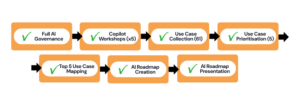
We ran a structured, org-wide process rather than guessing from the top down. Governance came first so AWC had the guardrails to move fast safely. Then five half-day workshops across every department built AI literacy and Copilot fluency while surfacing genuine use cases from the people who actually own the problems. AWC’s leadership then scored all 61 ideas against value, complexity, risk and mission fit, before we took the top five and mapped each one down to a build-ready technical blueprint.
- Governance before growth – most AI rollouts chase quick wins first and patch policy in later. We built AWC’s AI Policy, Risk Assessment and Governance Committee terms of reference before a single new capability launched, so responsible adoption was never an afterthought.
- Bottom-up, not top-down use cases – 61 ideas came directly from AWC’s own staff across all departments, not from a consultant’s assumption of what a conservation NFP “probably” needs.
- A real prioritisation process – every use case was scored for ROI, feasibility and risk with AWC’s leadership in the room, so the roadmap reflects AWC’s judgement, not just ours.
- Board-ready, build-ready – the roadmap wasn’t just a strategy deck. Each of the top five opportunities has its own detailed technical report, complete with a cost and timeline so it can be actioned straight away, and mapped back to AWC’s strategy with a clear ROI so leadership can see the value at a glance.
- A phased path that de-risks investment – start with Copilot quick wins to prove value fast, then move into custom agents once the foundations and internal capability are in place.
Result
AWC’s board now has a clear, prioritised, fully costed AI roadmap they helped shape themselves, worth an estimated $1.52 million a year in identified value once fully realised. Staff across the organisation are more confident and capable with Copilot day to day. Governance is in place so that confidence doesn’t turn into risk. And rather than the roadmap sitting in a drawer, AWC has already kicked off delivery, working with us to build their first custom agents inside Copilot Studio, turning the highest-value use cases from the roadmap into real tools their teams use.
The bigger shift is cultural. AI at AWC is no longer a handful of staff experimenting quietly with Copilot. It’s a shared, governed, board-endorsed strategy with a clear sequence for what gets built next.
Under the Hood
| Industry | Not-for-profit / Conservation |
| Governance | AI Policy, AI Risk Assessment, AI Governance Committee and Terms of Reference |
| Delivery | Five department workshops, use-case collection and prioritisation, top-five technical deep dives, board presentation |