Popular AI Usecases

Posted on Jun 30, 2026

One of the most common questions we get from business owners is: where do I actually start with AI?
Most businesses already have problems that AI is well suited to solve. They just don’t always recognise them yet.
Here are the most common ways we see businesses putting AI to work right now:
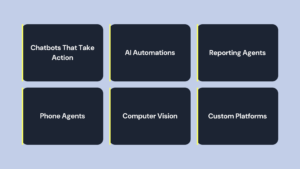
The frustration most businesses have with chatbots is that they can answer a question but can’t actually do anything.
The real value comes when an AI can work with the same systems your team works in every day, looking up a record, updating a CRM, triggering a workflow, or generating a document, without anyone having to switch tools or follow up manually.
These don’t have to live on your website either. An AI chatbot can sit inside Microsoft Teams, Slack, or whatever platform your team already uses, giving your people access to a capable assistant right where they’re already working.
The difference between this and a basic FAQ bot is that it can actually take action, not just point someone in the right direction. For businesses dealing with high volumes of internal requests or customer queries, this can make a significant difference to how efficiently work actually gets done.
Examples:
Find out more about chatbots.
Every business has tasks that follow a predictable pattern but still somehow end up on someone’s desk.
Processing forms, extracting information from documents, capturing leads from emails, updating systems manually. These are exactly the kinds of tasks AI handles well, running quietly in the background so your team doesn’t have to.
The best part is that these automations connect directly into the tools your team already uses. There’s no need to change how your business operates. AI just removes the manual steps in between, improving accuracy and freeing your people up for work that actually requires their judgement.
Examples:
Find out more about AI automation.
Pulling together reports manually is slow, error prone, and rarely anyone’s favourite job.
AI can take raw data from across your business and generate accurate, structured reports in seconds, in your format, with your branding, ready to send.
For teams that spend significant time each week compiling information for stakeholders or clients, this is one of the fastest ways to win back time. It also removes the inconsistencies that come with reports being produced manually by different people, every document comes out the same way, every time.
Examples:
Find out more about Reporting agents.
AI can now handle both inbound and outbound communication that would otherwise sit on your team’s plate.
Answering routine calls, sending job updates, appointment reminders, status checks, and capturing information from staff or customers, all without a human having to pick up the phone or send the message.
This is particularly valuable for businesses with staff working onsite or out in the field.
Rather than calling back to the office or logging into a system, employees can get or give information through a quick phone call or SMS, and it flows directly into your existing systems automatically. No manual data entry, no follow up required. For operations running high volumes of these routine interactions every day, it adds up quickly.
Examples:
Find out more about Phone agents.
AI can be trained to continuously monitor and measure what’s happening in a physical environment using cameras and visual data.
Rather than relying on manual checks or periodic reviews, AI watches in real time and flags when something falls outside the expected range, whether that’s a count that’s off, a defect on a production line, or a process that isn’t running the way it should.
For businesses that currently rely on people to manually measure, check, or record what’s happening on the ground, this kind of continuous monitoring improves accuracy, removes the gaps between manual checks, and gives you a much clearer picture of what’s actually going on in your operations.
Examples:
Find out more about Computer vision.
AI has made software development significantly cheaper and faster, whilst massively increasing the scope of what software can now do for a business.
Many companies have been burnt by off-the-shelf tools from vendors before, and are increasingly choosing to develop their own custom in-house platforms.
Rather than continuing to pay extensive license fees for existing tools, custom development allows organisations to build exactly what they need, integrating AI from the beginning rather than trying to add it on top of an existing legacy system.
Many clients even choose to keep their legacy software systems as a data layer, while building a fresh interface on top, making it significantly easier for staff and AI to interact with.
More and more organisations are realising the opportunity for AI to replace existing software systems and are building the next generation of software, with AI integrated properly from day one.
Here are some of the custom platforms our clients have created:
Find out more about custom development.
If you are unsure where to start, look at the biggest problems your business is facing first. There is a good chance that AI will be able to help and achieve at least an 80-90% cost reduction.
If you’re considering AI but aren’t sure where to begin, get in touch.