Introduction to AI

Posted on Jun 25, 2026

Everyone’s talking about AI. But before you can figure out if it’s right for your business, it helps to actually understand what it is, and more importantly, what makes it different from the software you already use.
Most businesses already rely on software to run their day-to-day. Accounting platforms, CRMs, booking systems. These tools are incredibly powerful, but they all share one thing in common: they work by following rules that someone has clearly defined.
Tell the software: if an invoice comes in, match it to a purchase order and log it. It will do that perfectly, every single time. But the moment something falls outside those rules, an unexpected format, a missing field, a situation nobody thought to plan for, the software stops and a human has to step in.
Software works by following rules. When those rules break so does the software.
When dealing with unstructured data like emails and documents, it’s simply not possible to create rules to cover every scenario. That’s where AI comes in.
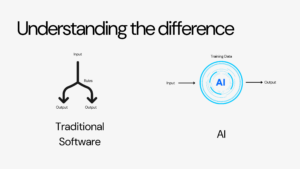
AI doesn’t require a strict set of rules to operate. It can work with any text, audio, image or video.
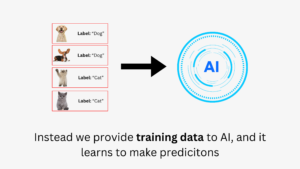
When AI is trained, it uses mountains of training data to learn the patterns required to complete different tasks.
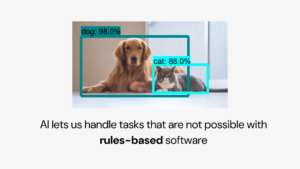
Think about your inbox. Every day, emails arrive that require a bit of judgement. A customer with an unusual request, a complaint that needs a careful response, a supplier chasing something that needs context before you reply. No rule can cover all of it. It requires understanding, nuance, and the ability to read a situation.
That’s exactly what AI is designed to do. Rather than following a fixed set of rules, AI is trained to recognise patterns, understand context, and make decisions in situations that aren’t black and white.
So if software handles the clearly defined tasks in your business, AI is what handles everything in between.
Let’s take a small business who has a simple website with a contact form that they want to connect to their CRM.
Software would be able to handle any rules-based workflow such as creating a new contact and lead, then copying over the email, phone number and name fields. This is the exact same process every time and there’s no need to get AI involved.
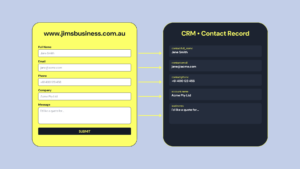
Now let’s say that every time a new lead came in, you wanted to automatically research the company and then send them a custom email with some relevant case studies specific to their business and requirements.
Researching the web involves way too many variables for software to be a solution here, and selecting relevant case studies would be crude at best if worked off a simple rule like keyword matching.
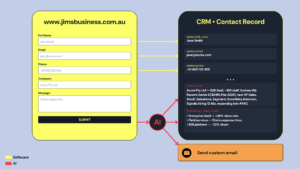
This is where AI comes in, to handle the tasks that are too complex for traditional software. For AI, the task of researching the web to find out more about the new contact and select relevant case studies is straightforward and easy to implement. With software, it would be impossible to get it performing well.
It is not a matter of choosing one or the other, software should be used where possible with AI doing what software is not able to accomplish.
Every business has gaps. Moments where the process breaks down and a person has to step in to use their judgement. Some of those moments are high value and absolutely should involve a human. But many of them are repetitive, time consuming, and quietly eating into your team’s day.
AI doesn’t replace your people. It takes the more complex, repetitive tasks that software can’t handle and handles them, freeing your team to focus on the work that actually needs them.
All of the gaps where software has fallen short in the past can now be filled with AI. We have seen how software has transformed the way businesses operate in the past, removing massive amounts of manual admin and repetitive work. AI presents that same opportunity on a much larger scale, able to go beyond simple rules-based task and being able to handle the dynamic, everchanging realities of day-to-day business.
If you’re considering AI but aren’t sure where to begin, get in touch.